


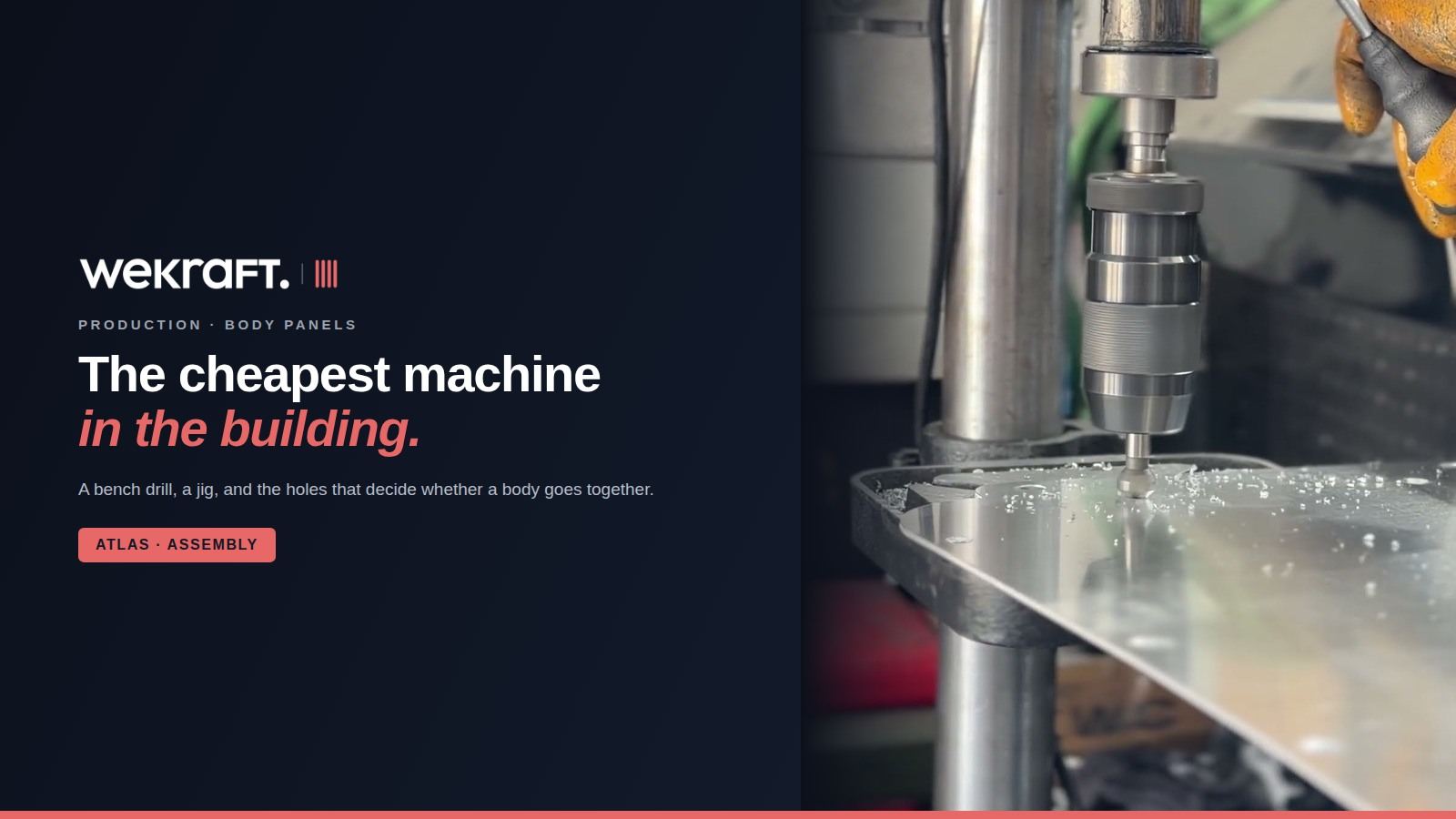
Last week we gave a whole post to a fibre laser. Here is the machine at the next station along, and it is a bench drill of the sort you would find in any workshop on any industrial estate. The holes it puts into a body panel are what decide whether that panel goes onto the turbine cleanly, or whether somebody spends twenty minutes with a round file working out why it will not.
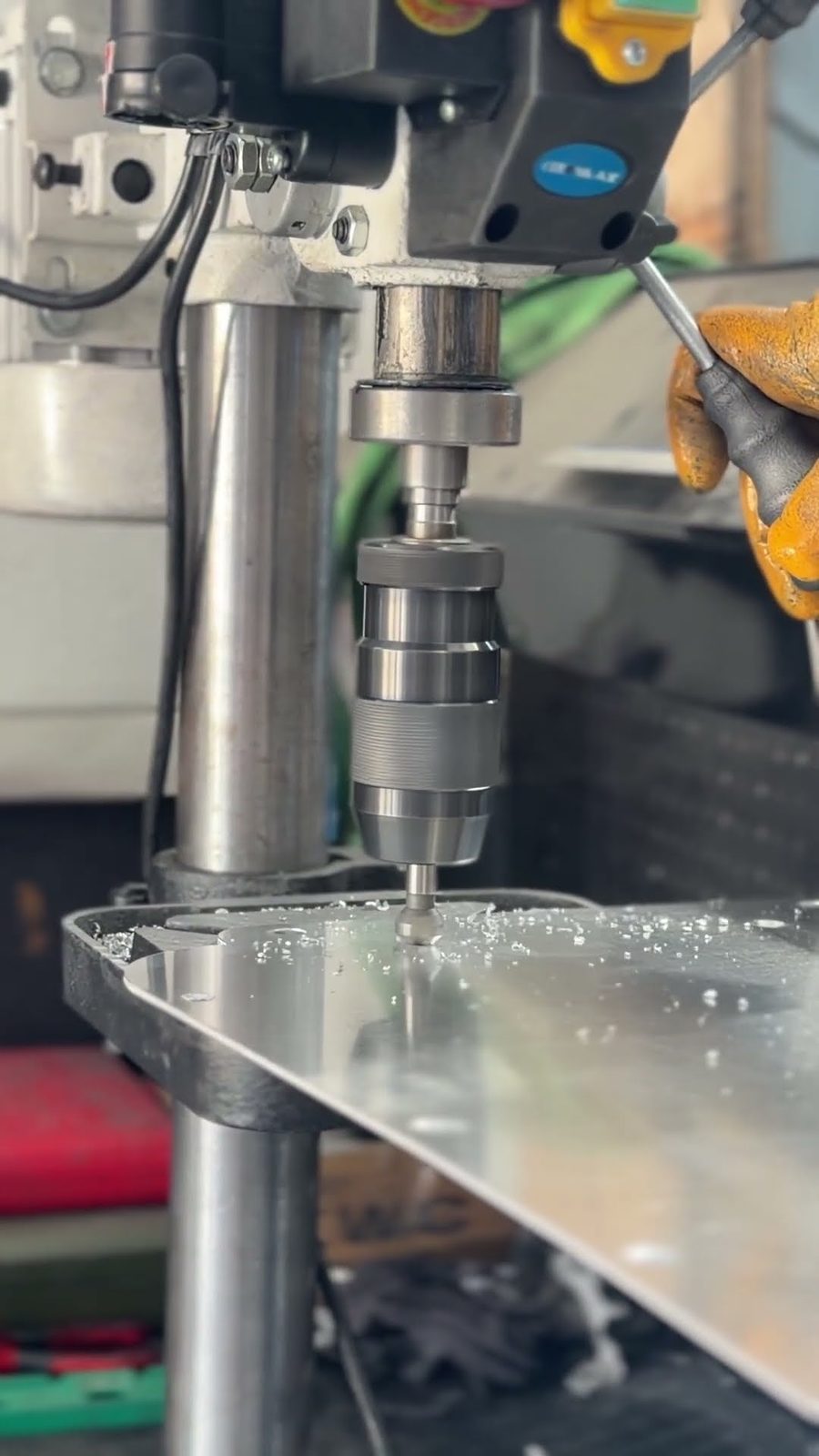
Mounting holes going into an aluminium body panel. The bright curls are swarf coming off the flutes; the notched edge at the left is a laser-cut profile from earlier in the same job.
The tolerance is not in the machine
A drill press has no idea where it is. It spins, it comes down, it goes back up. Nothing about it knows the difference between the right place and forty millimetres from the right place. What decides where a hole lands is the jig: a template that sits on the part and puts the bit in the same position on the first panel and on the five hundredth. The tolerance moves out of the operator's eye and into a piece of steel that does not get tired at four in the afternoon.
So when somebody asks whether this is CNC, the answer is no, and it is not the confession it sounds like. A CNC would locate the hole from a program and a datum. A jig locates it from the part itself, which for a panel that has already been cut and formed is not the inferior method — it is the method that references the thing you are actually holding rather than the thing the drawing said you would be holding.
A drill press does not know where it is. The jig does.
What a jig does not fix
Now the part that keeps this honest, because a jig is not a magic word. It is a wearing part. The bushes open up over time, and a hole that starts dead on position drifts as the guide it is drilled through gets wider. That means the jig has to be checked on a schedule, and it means that when a check finds drift, every panel drilled since the last check is a question rather than an answer. Nobody enjoys that conversation. It is still cheaper than the alternative, which is finding out at assembly.
Hand feed has its own limit. Aluminium is soft and it grabs on breakthrough — push too hard as the bit exits thin sheet and it will snatch, climb, and either tear the hole or take the panel with it. That is the whole reason the work is clamped and nobody drills a loose sheet, and it is the part of this job that lives in an operator's hands rather than in any fixture. You can buy a jig. You cannot buy the feel for the last half millimetre.
And the honest ceiling: this does not scale the way the laser does. A laser bed will run a nest of profiles while somebody is doing something else. A bench drill runs at the speed of one person and one panel. At our volumes that trade is fine, and pretending otherwise would be the kind of claim we spend these posts trying not to make. If we were building ten thousand a month, this photograph would look different, and we would tell you so.
Eight seconds, which is the whole point
The clip below is eight seconds long, and it is eight seconds because that is how long the operation takes. Most of manufacturing looks like this rather than like a factory tour: a short, unglamorous, entirely repeatable movement, done correctly, several hundred times. The interesting question is never whether the machine is impressive. It is whether the hundredth one comes out the same as the first. That is what the turbine you receive is actually made of.
Eight seconds on the bench drill. Watch it on YouTube if the player does not load.
The photograph and the clip are both ours, filmed this week on our own bench, unstaged and uncut. The still is a frame from the same eight seconds. Nothing here has been tidied up for the camera, which is why there is swarf on the panel and a glove in the corner of the shot.